Solid Wood vs. Veneer: How to Tell the Difference
"Solid wood" is one of the most stretched phrases in furniture. A lot of tables sold as wood are really a thin layer of real wood glued over particleboard or MDF. That's veneer. It isn't always bad, but it's a very different thing than what most people think they're buying.
Here's how to tell the difference, in a store or online.
What's the difference?
- Solid wood means the parts are made from real boards all the way through. Cut it anywhere and it's wood.
- Veneer is a thin slice of real wood, often thinner than a credit card, glued to a core. The core is usually particleboard, MDF, or plywood.
- Laminate isn't wood at all. It's a printed photo of wood grain on paper or plastic.
6 ways to tell in person
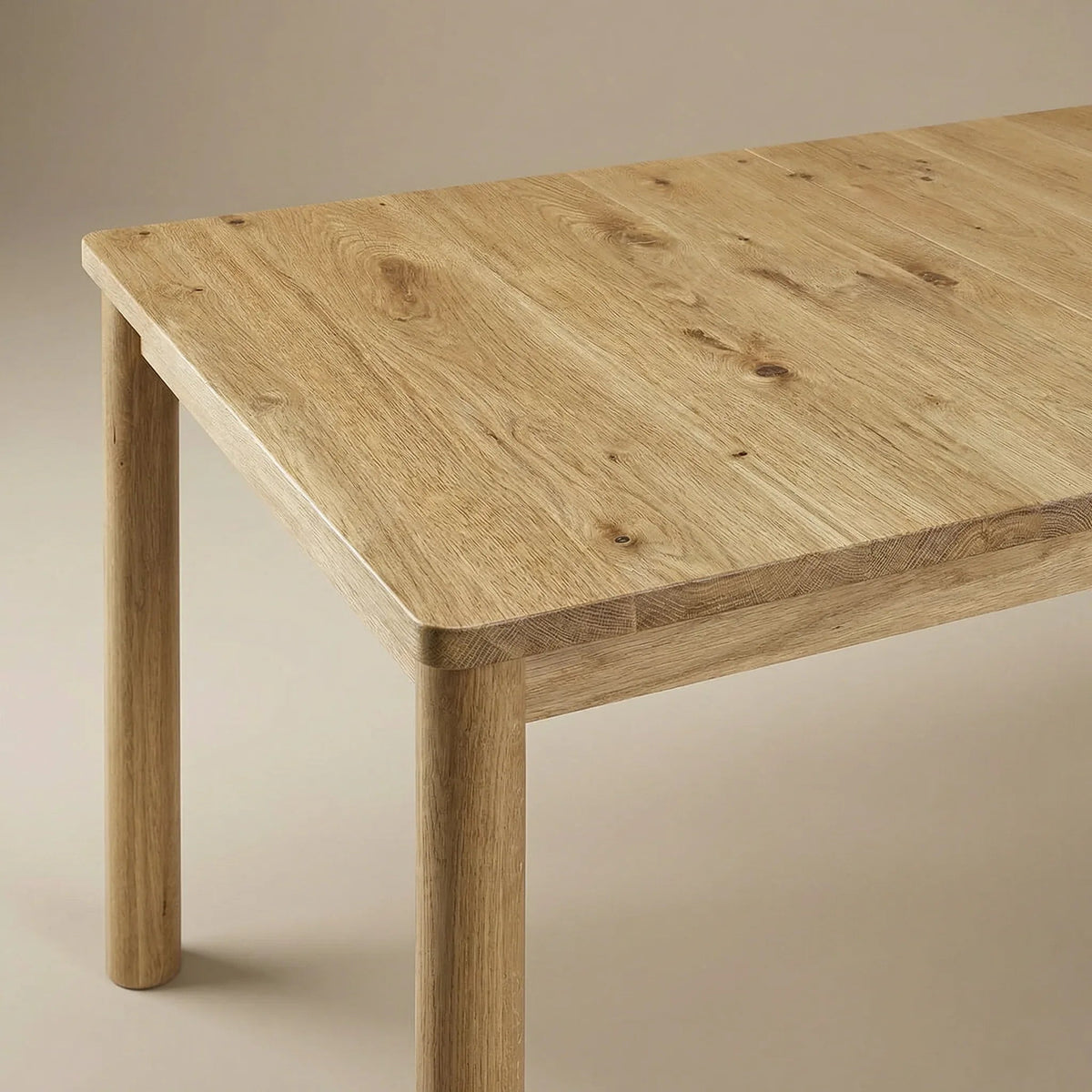
1. Look at the edge of the top. On solid wood, the grain on the top wraps around and continues down the edge. On veneer, you'll often see a thin line where an edge strip was glued on, or the edge pattern won't match the top.

Solid hardwood corner on our Ashford table. Real grain on the top, edge, and leg.
2. Check the end grain. The ends of a solid top show end grain, the little lines of the growth rings. A veneered top's ends look too smooth and uniform, or show a band.
3. Look underneath. Flip a chair or look under the table. Solid wood looks like the same wood on the bottom. Veneered pieces often show particleboard, MDF, or a different, cheaper wood underneath.
4. Find a repeating pattern. Every solid board is different. If a knot or grain swirl shows up again and again across the surface, it's probably printed laminate.
5. Feel the weight. Solid hardwood is heavy. A big dining table you can lift by yourself is a red flag.
6. Look at a screw hole or scratch. Particleboard shows up as compressed chips. Solid wood just shows more wood.
Watch the wording online
Listings use phrases that sound solid but aren't:
- "Solid wood construction" can mean the legs or frame are solid, while the top is veneer.
- "Wood veneer" or "engineered wood" means a core of particleboard, MDF, or plywood.
- "Hardwood solids and veneers" means it's a mix.
- "Made with real wood" doesn't say how much.
If a listing doesn't clearly say solid hardwood top, ask.
Is veneer ever the right choice?
To be fair, yes. High-end veneer can be beautiful, it's stable, and it can show off rare figured wood that would be too expensive as solid boards. The problem is cheap veneer over particleboard. It can't really be repaired. A deep scratch goes through to the core, water swells the particleboard, and it can't be sanded and refinished.
Why solid wood is worth it for a dining table
- It can be refinished. In 20 years, a solid top can be sanded and refinished and look new. Veneer can't.
- It handles real life. Dents and scratches stay surface-level and add character instead of exposing a core.
- It lasts generations. Paired with real joinery like mortise and tenon, a solid table outlives the people who bought it.

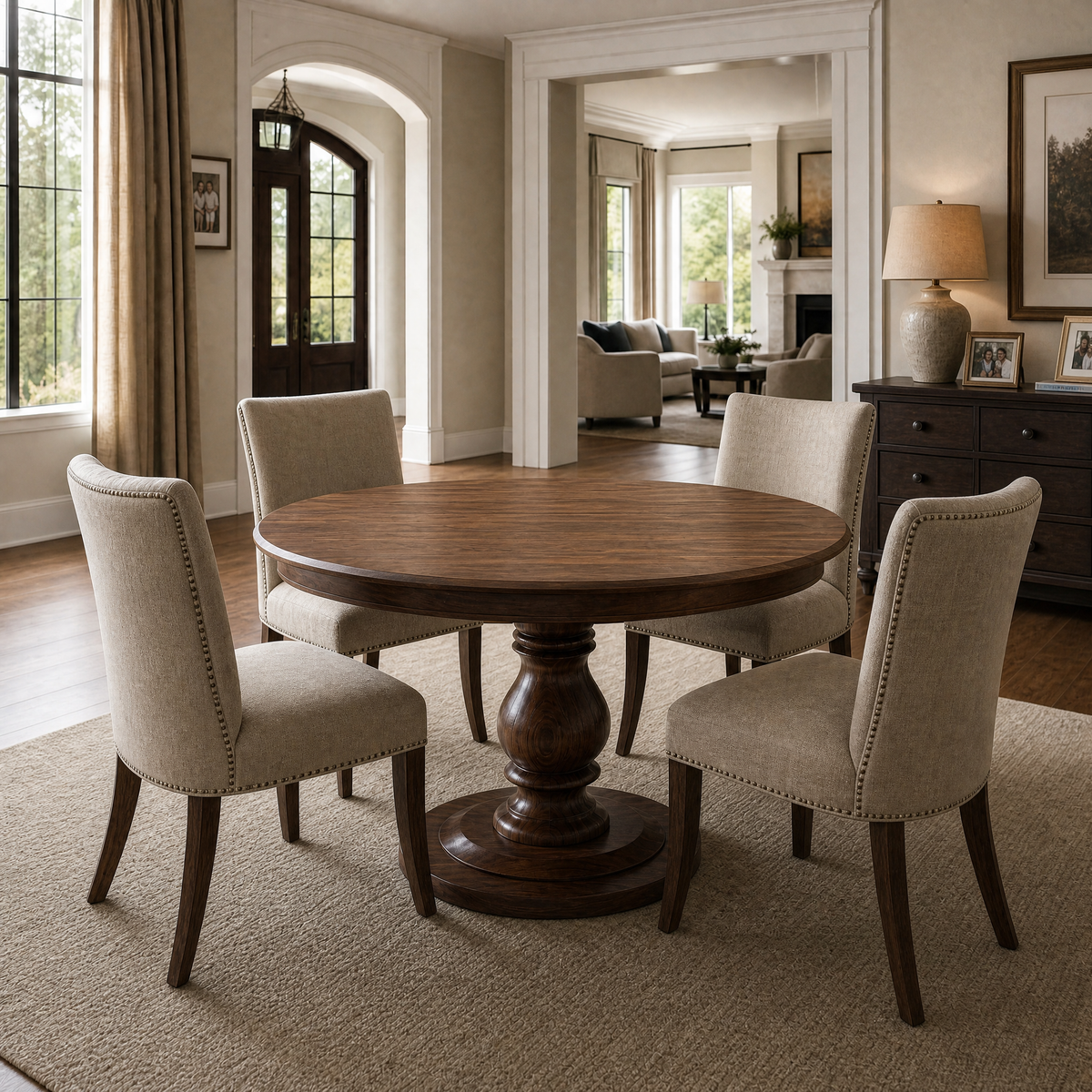
Grain detail on the Kestrel pedestal base.
How we build
Every TRM Woodcraft piece is 100% solid hardwood: walnut, white oak, red oak, maple, and cherry. No veneers, no MDF, no particleboard. Each one is handcrafted to order in Indiana, USA, and backed by a 5-year warranty.
See our solid wood dining tables or order real wood samples to feel the difference yourself.
Solid wood vs. veneer: common questions
How can I tell if a table is solid wood?
Check that the grain wraps from the top around the edge, look for real end grain on the ends, and look underneath for particleboard or MDF. Solid tables are also noticeably heavy.
Is veneer furniture bad?
Not always. Quality veneer can be beautiful and stable. Cheap veneer over particleboard is hard to repair and can't be refinished.
Can a veneer table be refinished?
Only lightly, if at all. The real wood layer is very thin, so sanding can go right through it.
Are TRM Woodcraft tables solid wood?
Yes. Every piece is 100% solid hardwood with no veneer, MDF, or particleboard.