Dining Tables With Leaves: Self-Storing vs. Removable
You seat four most nights and twelve at Thanksgiving. Do you buy the big table and live around it all year, or the small one and squeeze in? An extension table lets you have both. Here's how leaves work and which type fits how you live.
The Short Answer
An extension table pulls apart on slides so you can drop in one or more leaves. Removable leaves come out completely and get stored somewhere else, like a closet. Self-storing leaves fold and tuck inside the table, so they're always there when you need them.
Self-storing is more convenient. Removable leaves are simpler and work on more table styles. Many of our tables can be built with leaves. Just ask during your consultation.
How Much Does a Leaf Add?
Plan on about 24 inches of table edge per person. So every 24 inches you add gives you one more seat on each side.
| Table closed | Leaves added | Table open | Seats about |
|---|---|---|---|
| 60" | One 12" | 72" | 6 |
| 72" | Two 12" | 96" | 8 to 10 |
| 84" | Two 12" | 108" | 8 to 10 |
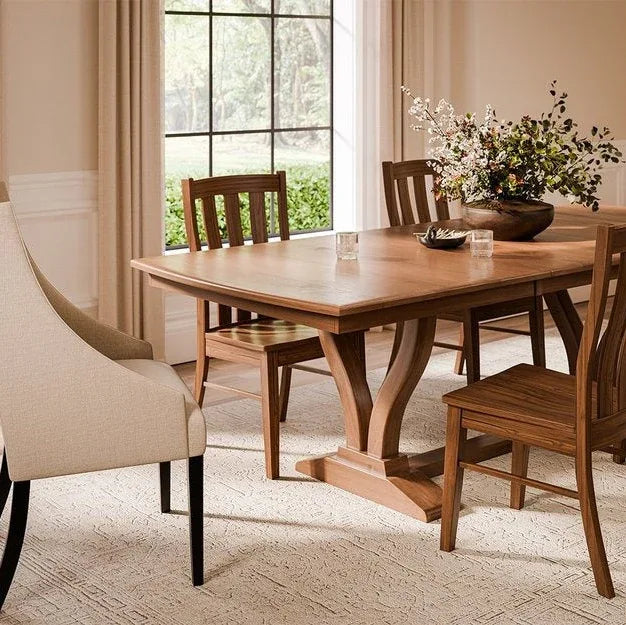
Our Hollis Dining Table offers optional 12" leaves, for example.
Check your room for the open size, not just the closed one. You'll want at least 36 inches from the table edge to the wall, and 42 to 48 inches if it's a walkway. Our dining table size guide has the full seating chart.
Removable Leaves
The table opens on slides, you set the leaves in, and you close it up. When you're done, the leaves go back in storage.
Pros: simple, works with most base styles, no bulk hidden under the top.
Cons: you need a place to store them, and they have to be carried out every time.
Self-Storing Leaves
The leaves live inside the table. Pull the ends apart and the leaf flips or slides up into place. Our Everett Trestle Table uses geared slides that open both ends evenly, with built-in leaf storage.
Pros: no storage closet, quick to set up, leaves never get lost or damaged.
Cons: the mechanism takes space under the top and usually costs more.
One Thing People Don't Expect
Solid wood changes color with light over time. Walnut slowly lightens, and oak and cherry warm up. Leaves that live in a closet don't get that light, so they can look a little different from the top at first. The easy fix is to put the leaves in now and then, especially in the first year, so everything ages together.
Extension Tables: Common Questions
What are self-storing leaves?
Leaves that fold or slide inside the table when not in use, so you don't need anywhere else to store them.
How big are dining table leaves?
Usually 12 to 20 inches each. Our Hollis, for example, uses 12-inch leaves.
How many people does a leaf add?
About 24 inches of added length gives one more seat on each side, so two people.
Do extension tables wobble?
A well-built extension table shouldn't. Good slides and a properly sized base keep it solid, open or closed.
Can I add leaves to a table later?
Usually not. Leaves need slides and a split top built in from the start. If you think you'll want them, plan for them up front.
Ready to Start?
Tell us how many people you seat most nights and on your biggest holiday, and we'll design a table that handles both. Browse our dining tables or book a free consultation.